Thirty charity-years, three Decembers and one question: when British Muslim charities asked donors to give at the end of the year, what reason did they give? Wusul reviewed the dated public record of ten charities from 2023 to 2025 and compared it with what their American counterparts said in the same weeks.
One charity network, two Decembers
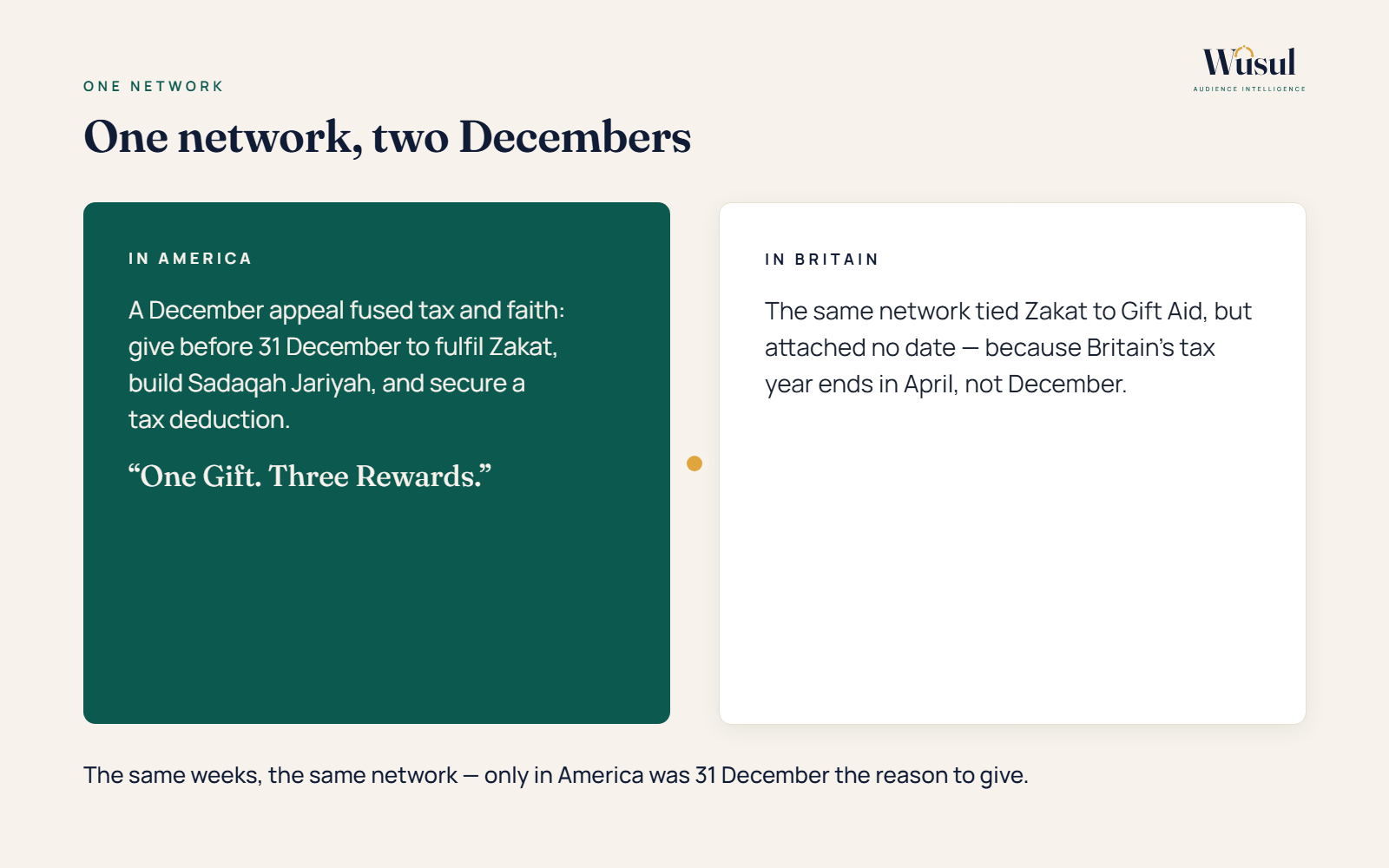
In December 2025, Human Appeal's American website ran an appeal called Give Beyond 2025. Its message was direct: give before 31 December, and one gift would fulfil the donor's Zakat, build Sadaqah Jariyah and deliver a tax deduction. "One Gift. Three Rewards."
Human Appeal's British Zakat policy, in a version dated that same December, also ties Zakat to tax relief, but in a completely different way: the charity runs a 100% Zakat policy with Gift Aid, and when donors tick the Gift Aid box, the Gift Aid reclaimed from the government covers administrative costs so that the whole Zakat gift reaches its programme. No date is attached. There is no reason to attach one: Britain's tax year ends in April.
The same charity network, in the same weeks, linked Zakat to tax relief in both countries. Only in America did it make 31 December the reason to give.
That contrast is the starting point for this article. The previous article showed that 31 December has no tax significance for British donors. This one asks what British Muslim charities actually did with the end of the year. Wusul reviewed the dated public record of ten charities across December 2023, 2024 and 2025, thirty charity-years in all, and classified what it found. The short answer is that the year-end appears in British Muslim fundraising far less often, and far less explicitly, than winter, Gaza and Zakat do.
Ten charities, thirty cases, four kinds of evidence
The sample is ten British Muslim charities of different sizes and models: Islamic Relief, Human Appeal, Muslim Hands, Muslim Aid, Penny Appeal, Ummah Welfare Trust, the National Zakat Foundation, Al-Khair Foundation, UK Islamic Mission and One Nation. Each contributes three cases, December 2023, 2024 and 2025, giving thirty charity-years. The sample is varied by design; it is not statistically representative of every Muslim charity in Britain.
For each case, Wusul looked for dated public evidence in charity websites and appeal pages, press releases, annual and impact reports, event listings and fundraising platforms such as JustGiving. Each case was then placed in one of four categories, using the strongest evidence found:
| Category | What it requires |
|---|---|
| A. Year-end campaign | A campaign or fundraiser explicitly closing on, or tied to, 31 December |
| B. December fundraising activity | A dated appeal, event or announcement asking for support in December, but not tied to the year-end |
| C. Results only | Winter, Zakat or annual results covering the period, but no dated December fundraising request found |
| D. No dated December evidence | Nothing found that can be dated to that December |
*Three cautions apply. A case in category D does not mean the charity did nothing in December: emails, paid social media posts and temporary pages often leave no public trace, and smaller charities rely more on mosques and messaging groups that are not archived. The classification is provisional and will change as archived pages are checked. And a result, such as people helped, is never treated as money raised, nor an annual figure as December income.
The evidence matrix
The matrix shows the strongest dated evidence found for each of the thirty cases.
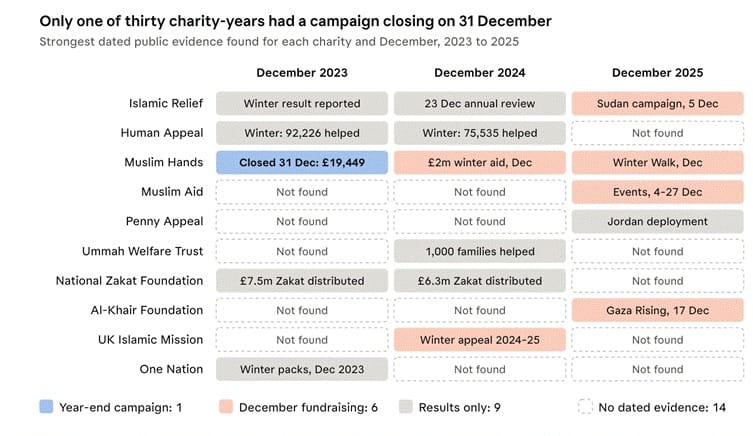
Measured against the series' three indicators, using all thirty cases as the denominator:
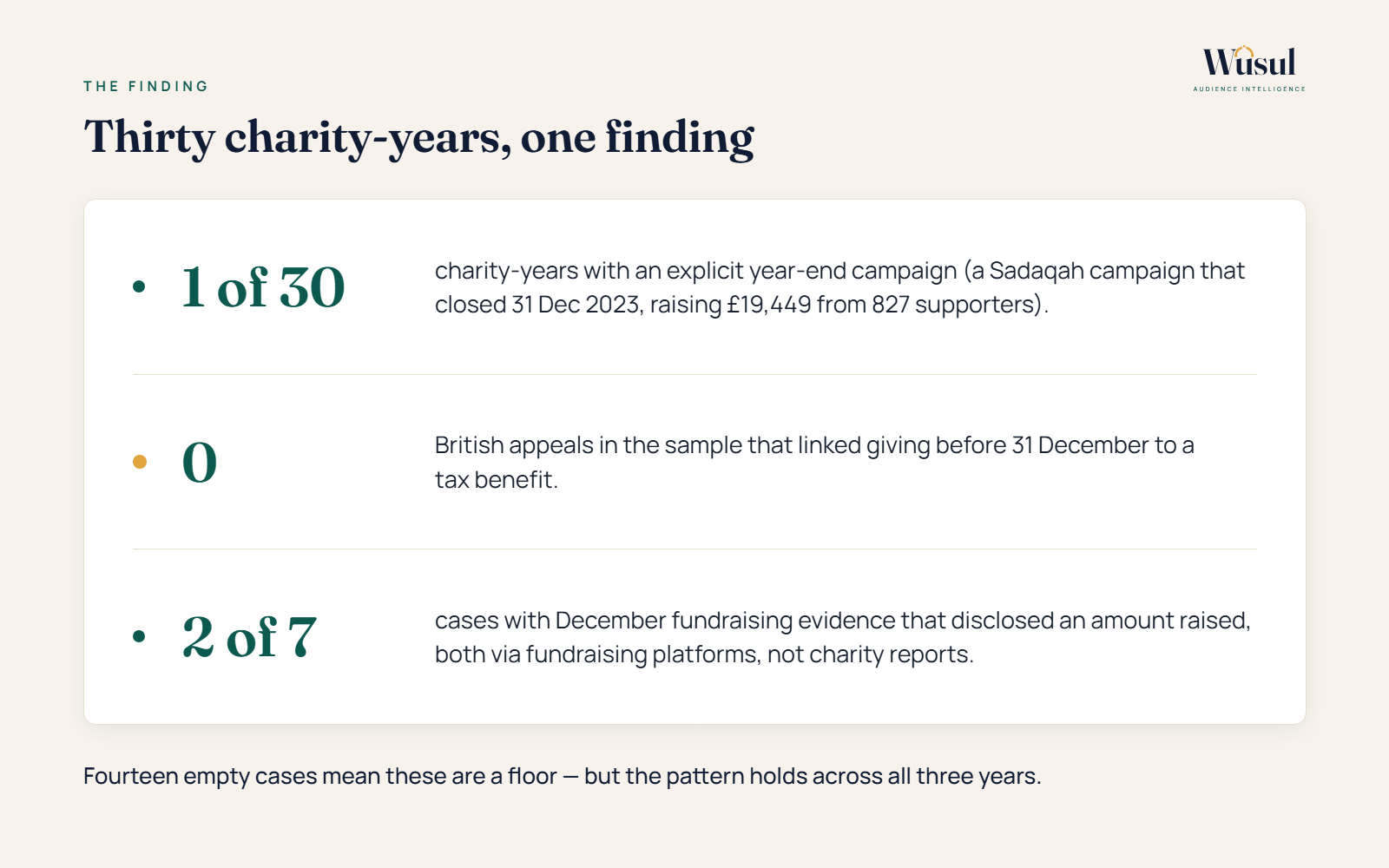
- Year-end campaigns found: 1 of 30.
- Year-end campaigns with a tax message: 0 of 1 found. No dated British appeal in the sample linked giving before 31 December to tax relief.
- Campaign results disclosed: 2 of the 7 cases with December fundraising evidence show an amount raised, both through fundraising pages rather than charity reports: the Muslim Hands campaign that closed on 31 December 2023, and a Muslim Hands Gaza Winter Walk fundraiser in 2024-25.
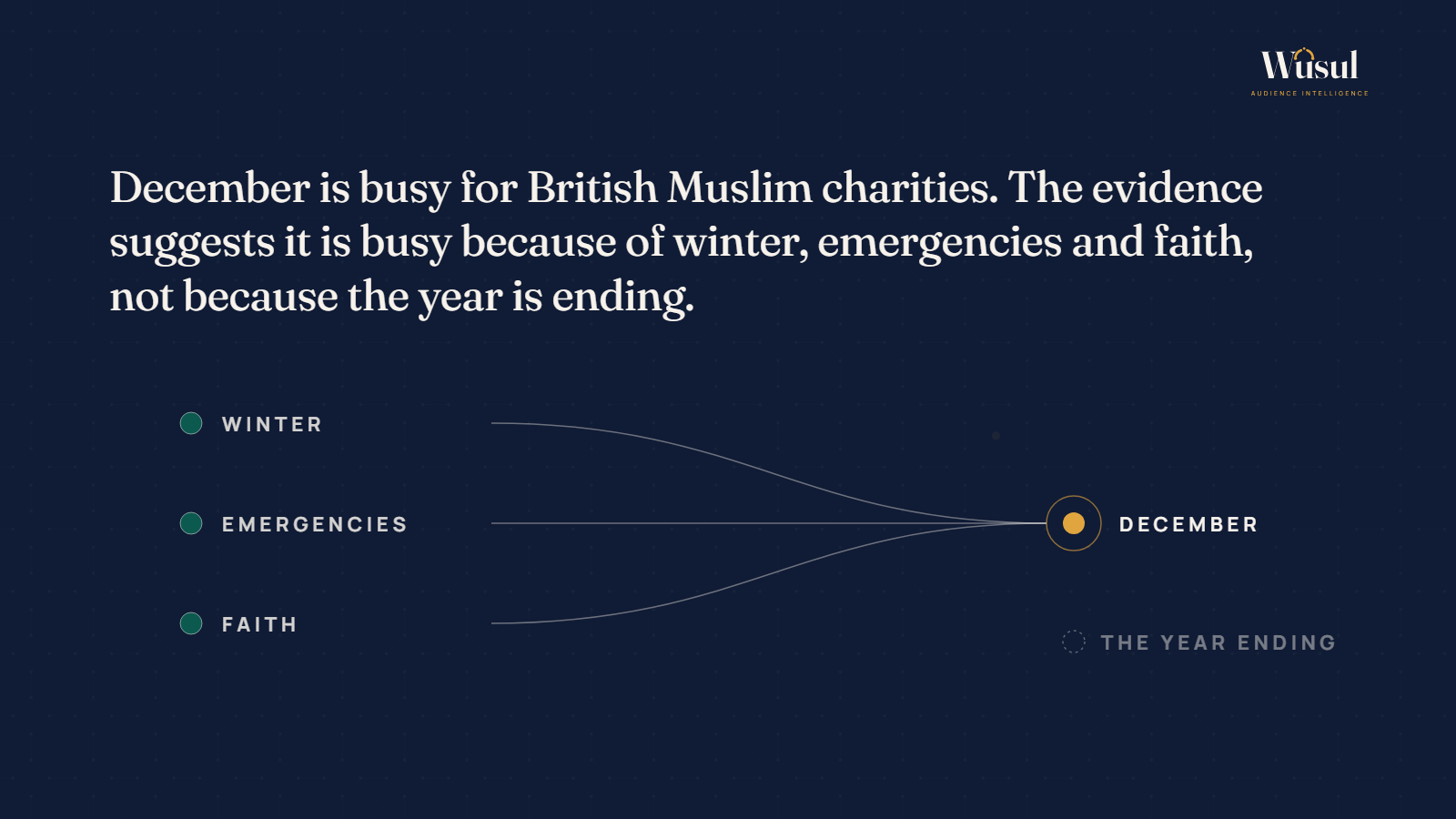
The numbers are small, and the 14 empty cases mean they should be read as a floor, not a final count. But the pattern is consistent across all three years: British Muslim charities fundraise intensely in December, and rarely say the year-end is the reason.
December 2023: an emergency overtook the calendar
The final quarter of 2023 was dominated by the war in Gaza. For British Muslim charities, Palestine became the centre of fundraising from October onwards, and that changes how any December result from that year can be read. An appeal that did well in December 2023 may have done well because of Gaza, not because the year was ending. Without daily donation data, the two cannot be separated.
Against that background, the only British campaign in the sample with an explicit 31 December closing date stands out. Muslim Hands ran a JustGiving campaign, Empowering Communities Through Your Sadaqa, which closed on 31 December 2023 having raised £19,449 from 827 supporters. It is a modest sum for a charity of Muslim Hands' size. But it is the clearest example in the review of a year-end campaign with a public result: a defined end date, an amount raised and several donors. Notably, it asks for Sadaqah, voluntary charity, rather than Zakat, which has no Gregorian deadline.
The rest of the 2023 evidence is about delivery rather than fundraising. Human Appeal's winter report for 2023-24 records support for 92,226 people in seven countries. Islamic Relief reported in February 2024 that its UK Winter Food Drive had reached more than 40,000 people with 28 partners. One Nation's annual report for October 2023 to September 2024 documents winter distributions photographed in December 2023 and January 2024, and lists 29,900 bedding packs, 29,900 clothing packs and 29,900 heating packs. The three identical totals suggest a standard bundle given to each household, so they most likely describe 29,900 bundles, not 89,700 separate gifts or people. The National Zakat Foundation reported distributing about £7.5 million to some 30,000 people across the year.
All of these show that the money was used. None shows what a December appeal raised.
December 2024: the evidence becomes specific
December 2024 produced the most detailed public record, and the clearest examples of how easily different numbers can be confused.
Muslim Hands issued a statement that month announcing what it called its record-breaking winter appeal: about £2 million in winter aid across nine locations, more than £1 million of it for Gaza, with plans for some 1.7 million hot meals. It is the strongest dated December fundraising evidence in the sample. But the £2 million describes aid to be delivered, not money raised that month, and the meals were a plan, not a completed result.
UK Islamic Mission ran a Winter Emergency Appeal for 2024-25, with fixed donation amounts and Zakat-eligible giving for families in Syria, Lebanon, Afghanistan, Yemen and Pakistan. The appeal is documented; its total is not.
The other 2024 evidence again reports what was done. On 23 December, Islamic Relief published its review of the year, saying its work had touched more than 17 million lives. That is a different kind of December message: not a request but a thank-you, closing the year with results rather than urgency. Human Appeal reported winter help for 75,535 people in nine countries between November 2024 and March 2025, a season that straddles the year-end. Ummah Welfare Trust reported on 2 January 2025 that it had given vouchers to 1,000 flood-affected families in Bangladesh at the end of 2024. And the National Zakat Foundation distributed about £6.3 million to some 25,000 people during the year.
None of these is wrong or misleading. They are simply answers to a different question from the one this article asks. They say what December's money helped to do. They do not say why donors were asked to give in December, or how much a December request raised.
December 2025: events, not deadlines
In December 2025, the year-end appears mostly as a backdrop to events.
Muslim Hands organised its Gaza Winter Walk as a series running across the winter: Manchester on 29 November, Birmingham on 6 December, Nottingham on 13 December and London in January 2026. The year-end falls in the middle of the series, not at its end. The walk's fundraising pages show what disclosure can look like: one group page from the 2024-25 edition displayed about £111,000 raised against a £110,000 target. That figure belongs to one fundraiser over a whole season, not to the event as a whole or to December alone.
Al-Khair Foundation advertised a Gaza Rising fundraising evening in Luton on 17 December, for food, medical aid, winter essentials and shelter, at a venue holding 600 people. Muslim Aid ran a Build Your Wealth tour on Islamic financial literacy from 4 to 14 December and took part in a Winter Soirée on 27 December, speaking about its work in Gaza and Sudan. Islamic Relief held a London event on 5 December for its campaign Are Your Eyes on Sudan? aimed as much at public attention as at donations. Penny Appeal sent a volunteer deployment to Jordan in December, serving meals and supporting shelter work for Syrian refugees and Gaza-related aid, part funded by a comedy tour.
Each of these has a reason for its timing: a walk, an evening, a crisis, a deployment. None of them gives 31 December as the reason to give. Several are not primarily about money at all.
One British example from outside the review window points the same way. Human Appeal's UK homepage this autumn advertises a series of events from 11 to 31 December in 21 cities, in aid of its Orphan Appeal, alongside its winter coat collection. The December calendar is busy, and the year-end is the setting, not the argument.
What the appeals said, and the tax message that was missing
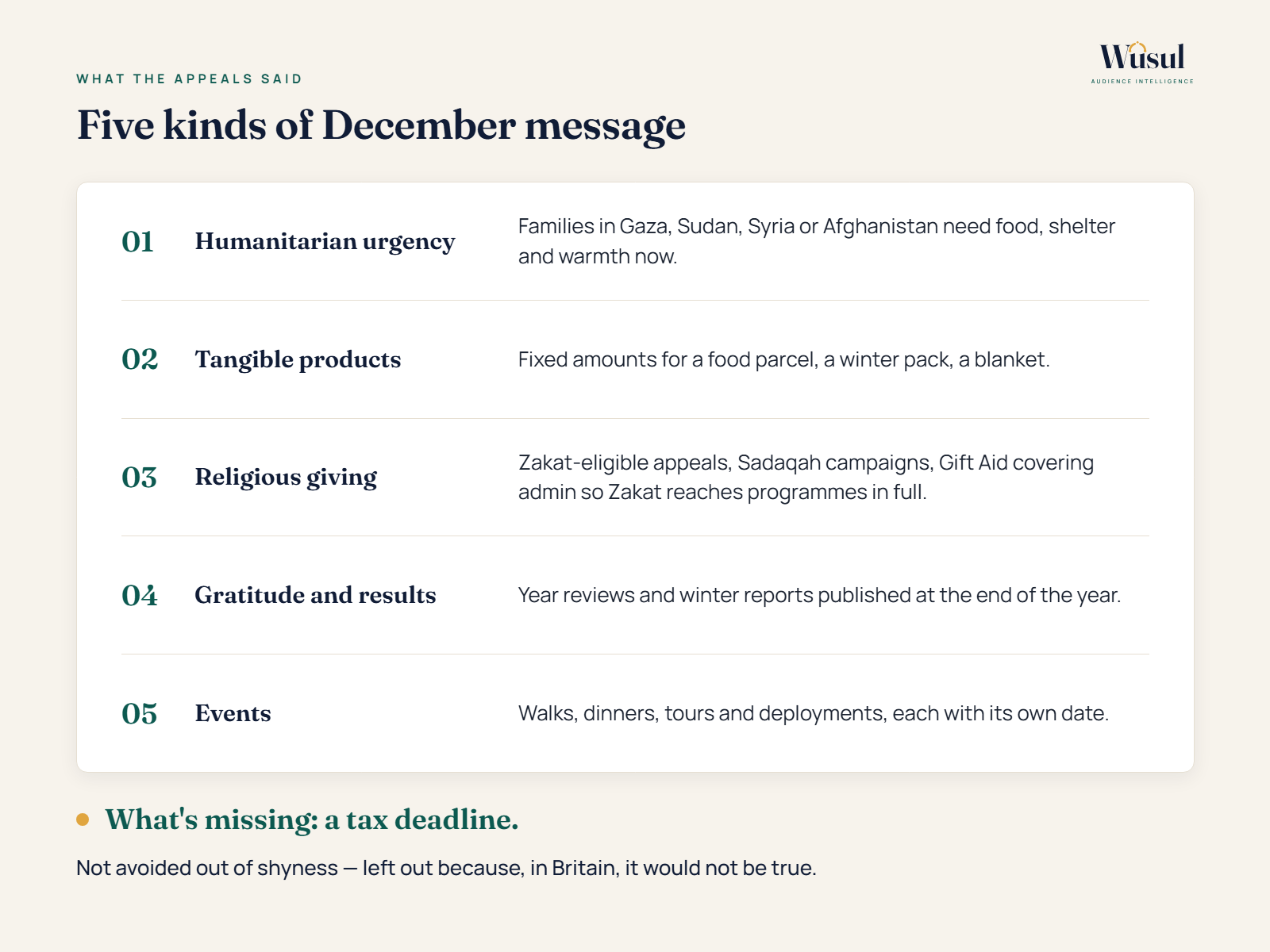
Across the thirty cases, December messages fell into five patterns:
- Humanitarian urgency: families in Gaza, Sudan, Syria or Afghanistan need food, shelter and warmth now.
- Tangible products: fixed amounts for a food parcel, a winter pack or a blanket.
- Religious giving: Zakat-eligible appeals, Sadaqah campaigns, and, in Human Appeal's case, a promise that Gift Aid covers administration so Zakat goes to programmes in full.
- Gratitude and results: year reviews and winter reports published at the end of the year.
- Events: walks, dinners, tours and deployments with their own dates.
What is missing is a tax deadline. In the records found, no British charity in the sample told donors that giving before 31 December would secure Gift Aid or any other tax benefit. That is accurate, because nothing about Gift Aid changes on 31 December. Gift Aid appears instead as a box at checkout, in Zakat policies, and on fundraising platforms: JustGiving pages show it separately, so that Human Appeal's 2025 challenge events, for example, display £87,482 raised plus £14,898 in Gift Aid.
Across the Atlantic, the same weeks sounded very different. Besides Human Appeal's Give Beyond 2025, Zakat Foundation of America published a post on 8 December 2025 urging donors to give before December 31 to take advantage of a tax-deductible donation. The Human Development Fund's appeal asked donors to give Zakat to Gaza and to ensure it was tax-deductible by giving by December 31. In America, the year-end tax deadline and Zakat are fused into a single call to act. In Britain, in the records reviewed, they never are.
That is the clearest finding of this article. British Muslim charities are not avoiding year-end urgency because they are shy of it; their American counterparts, sometimes in the same network, use it readily. They appear to leave it out because, in Britain, it would not be true. The Part II articles examine the American messages in detail, including whether they explain who can actually deduct a gift.
Money raised is not assistance delivered
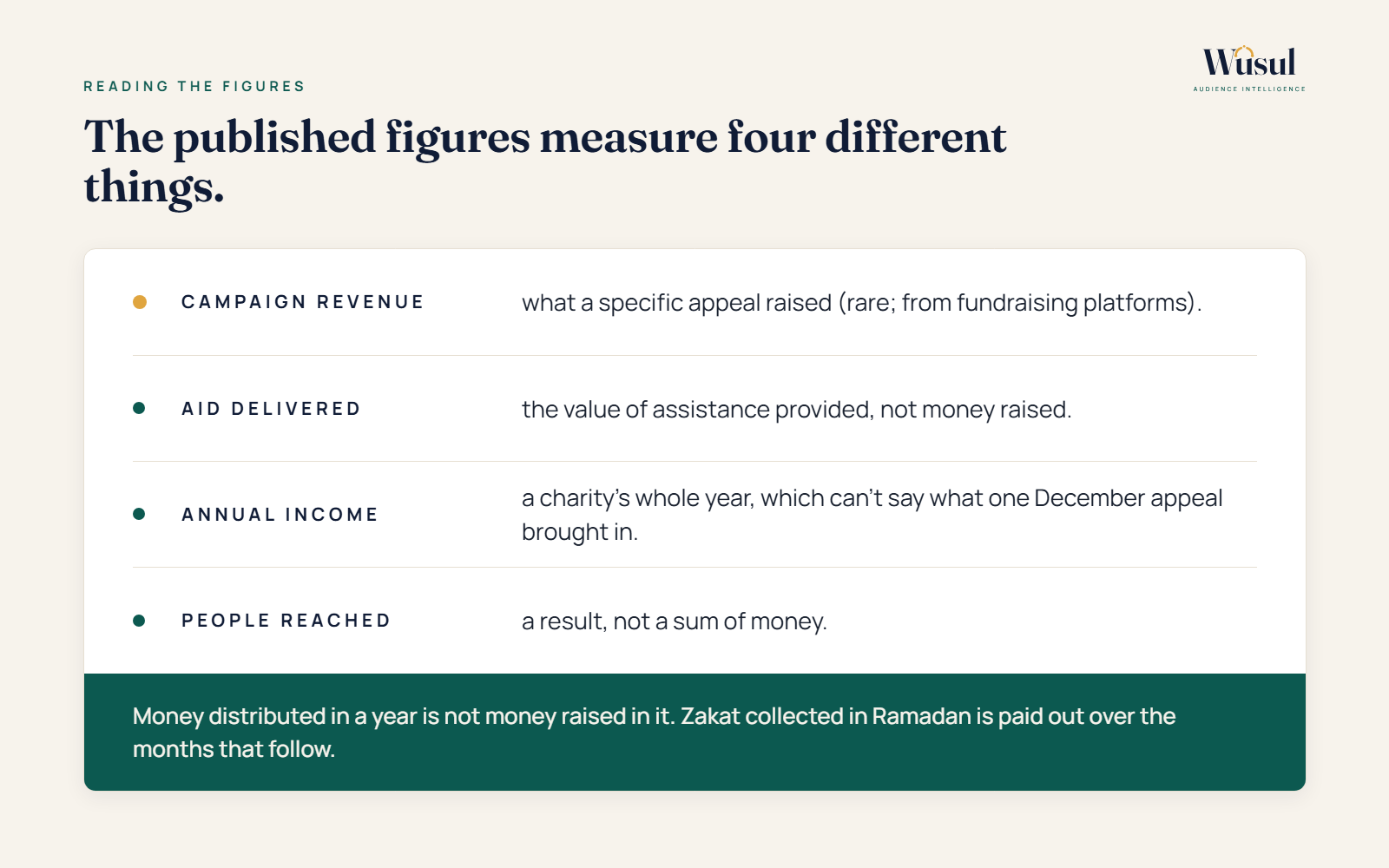
The published figures in this review measure at least four different things, and they cannot be added or ranked:
| Figure | What it measures |
|---|---|
| Muslim Hands, £19,449 (closed 31 Dec 2023) | Money raised by one dated campaign |
| Muslim Hands Winter Walk page, about £111,000 (2024–25) | Money raised by one fundraiser across a season |
| Muslim Hands, about £2 million (Dec 2024) | Value of aid announced for a winter response |
| Human Appeal, 92,226 people (winter 2023–24) | People reached by a winter programme |
| National Zakat Foundation, £6.3 million (2024) | Zakat distributed over a year |
| Islamic Relief, £48.2 million (2025) | UK donations, appeals and events for a whole year |
Only the first two are campaign revenue, and both come from fundraising platforms rather than charity reports. Annual accounts can say how much a charity raised in a year; Islamic Relief's 2025 notes, for example, show UK donations, appeals and events of about £48.2 million, down from £53.0 million in 2024, with Gift Aid of about £6.0 million, down from £7.4 million. They cannot say which December appeal contributed what. That is not a failure of financial transparency; it is a limit on what annual accounts are designed to show.
A pattern worth watching
The review was not designed to measure fundraising trends, but some of the published figures for 2024 and 2025 point the same way:
- Human Appeal's winter reach fell from 92,226 people in 2023-24 to 75,535 in 2024-25, about 18% lower.
- Islamic Relief's UK donations, appeals and events fell about 9% between 2024 and 2025, and its Gift Aid about 19%.
Over a similar period, Gift Aid across all UK charities rose: by 7% in the tax year to April 2025 and by 10% in the year to April 2026, as the previous article noted.
The National Zakat Foundation is a useful warning against reading too much into such figures. Its distributions fell from about £7.5 million in 2023 to about £6.3 million in 2024, which on its own might look like part of the same decline. But its accounts show that its Zakat income rose over the same period, from about £7.1 million to about £8.0 million, as the next article sets out. Money distributed in a year is not money raised in that year: Zakat collected in Ramadan is paid out over the following months, and reserves move between years.
The same caution applies to the other figures. Winter reach depends on costs and needs as well as income, and 2023-24 was an exceptional emergency year. Two charities are not a trend. But if large British Muslim charities were raising less while the wider sector's Gift Aid grew, that would matter, and it is worth testing properly. Article 5 of this series looks at what the accounts can and cannot show.
Conclusion: what did the year-end appeals say?
Mostly, they did not say "year-end" at all. Across thirty charity-years, the public record shows one British Muslim campaign that explicitly closed on 31 December, a Sadaqah campaign by Muslim Hands in 2023 that raised £19,449. It shows six more cases of dated December fundraising, built around winter, Gaza, Sudan and events. It shows nine cases where charities reported what their winter or Zakat work delivered. And it shows fourteen cases where nothing dated to December could be found.
In none of the records reviewed did a British charity in the sample tell donors that 31 December mattered for tax. In the same December, American Muslim charities, including one in the same network, told donors exactly that, and linked it to Zakat. The contrast suggests that British Muslim charities shape their December messages to the British tax calendar, just as their American counterparts shape theirs to a tax year that really does end on 31 December.
Two simple changes would make the next comparison stronger. Charities could keep their December appeal pages online, or archived, with their dates and wording intact. And for any appeal with a deadline, they could publish a short note afterwards: the dates, the reason for the deadline, the amount raised with Gift Aid shown separately, and what the money funded. The one British year-end campaign in this review that disclosed its result did so through a fundraising platform, not through the charity's own reporting.
Frequently asked questions
Did British Muslim charities run year-end appeals in 2023-2025?
Rarely, on the public evidence. Of thirty charity-years reviewed, one campaign explicitly closed on 31 December: a Muslim Hands Sadaqah campaign in 2023. Six more cases showed December fundraising built around winter, emergencies or events.
Did any British charity in the sample use a December tax deadline?
Not in the records found. That is consistent with UK rules: Gift Aid does not change on 31 December, because the tax year ends on 5 April.
Do American Muslim charities use the year-end differently?
Yes. In December 2025, Human Appeal USA and Zakat Foundation of America linked giving before 31 December to tax deductions, Human Appeal explicitly alongside Zakat. The Human Development Fund has run a similar year-end Zakat appeal.
Can annual accounts show how much a December appeal raised?
Not on their own. Accounts show annual income; campaign results need campaign-level disclosure. The two campaign totals found in this review came from fundraising platforms.
Does "no evidence found" mean a charity did nothing in December?
No. Emails, social media posts and temporary pages often leave no public trace. It means only that no dated public evidence was found.
Wusul Insight: In Britain, December is a fundraising season, not a fundraising deadline. Across ten British Muslim charities and three years, the public record shows winter, Gaza, Zakat and events driving December appeals, and almost no use of the year-end itself. The same charity networks speak very differently to American donors, for whom 31 December is a real tax deadline.
Methodology note*: the sample is thirty charity-years (ten British Muslim charities, December 2023 to 2025). Each case was classified by the strongest dated public evidence found in charity websites, press releases, reports, event listings and fundraising platforms. The classification is provisional: archived web pages have not yet been checked systematically, and campaigns run through email, social media or temporary pages may be missing. "Not found" means no dated public evidence was located, not that no activity took place. Programme results are not treated as money raised, nor annual figures as December income. Fundraising-page totals may have changed since they were viewed. The American examples are cited for comparison and are examined in Part II.