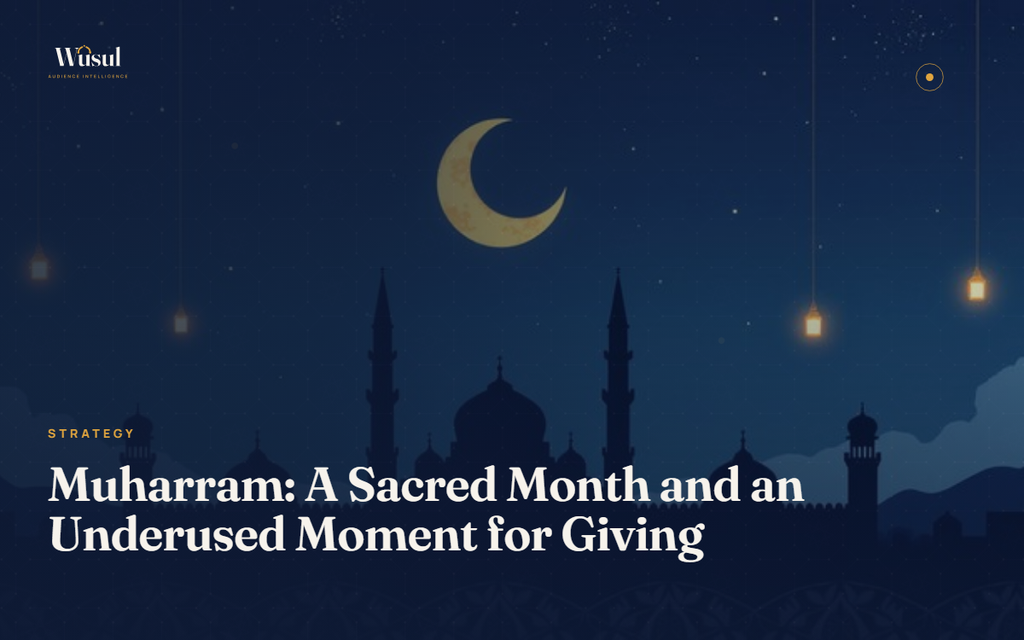
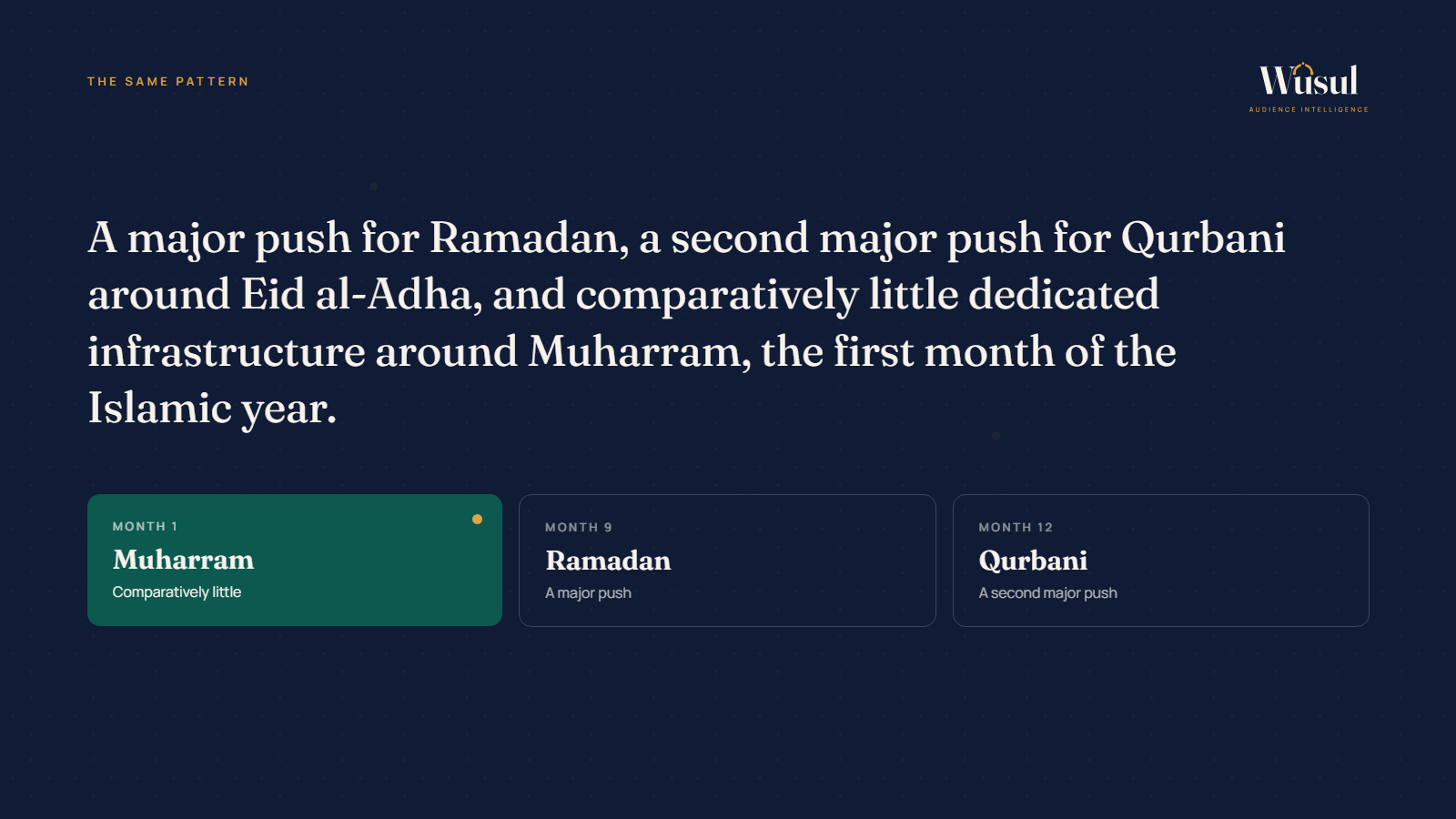
Muharram significance for charity is rooted in the fact that good deeds performed during the four sacred months carry amplified spiritual significance. Muharram significance is rooted in the fact that good deeds performed during the four sacred months carry amplified spiritual significance. Walk through almost any Islamic charity's annual campaign calendar and you'll find the same pattern: a major push for Ramadan, a second major push for Qurbani around Eid al-Adha, and comparatively little dedicated infrastructure around Muharram, the first month of the Islamic year. This matters directly for the Cultural Intelligence Gap, because it's a case where genuine religious significance and actual fundraising behavior have drifted apart; not because Muharram lacks spiritual weight, but because most organizations haven't built a campaign muscle around it the way they have for the other two seasons.
The opportunity here isn't a marketing trick. It's recognizing that Muharram carries a distinct psychological frame, the start of a new year, a natural moment for reflection and resolution, that most donors experience whether a charity ever mentions it.
What makes Muharram religiously significant?
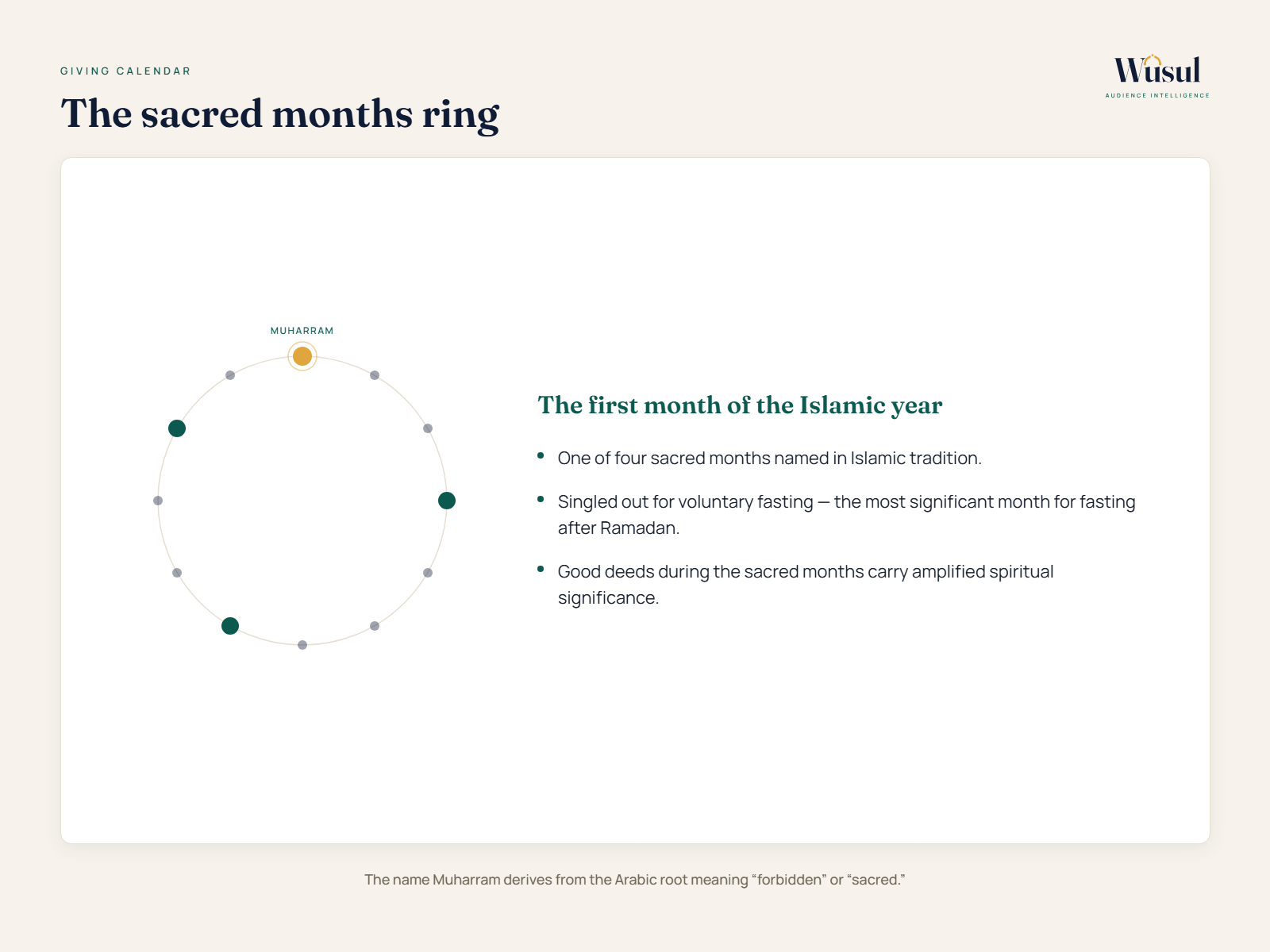
Muharram is one of four sacred months named directly in Islamic tradition. The name Muharram itself derives from the Arabic root meaning "forbidden" or "sacred," highlighting its status as a month in which fighting was traditionally prohibited. As the Qur'an states:
"Indeed, the number of months with Allah is twelve [lunar] months in the register of Allah from the day He created the heavens and the earth; of these, four are sacred.", Qur'an 9:36
The Prophet Muhammad (PBUH) specifically highlighted Muharram's virtue for voluntary fasting, describing it as the most significant month for fasting after Ramadan. A hadith recorded in Sahih Muslim states:
"The best fasting after Ramadan is the month of Allah, Muharram.", Sahih Muslim
Scholars have noted that good deeds performed during the four sacred months carry amplified spiritual significance, and several early Islamic scholars (Tab'iun) selected Muharram as the best of these sacred months. Hafiz Ibn Rajab further specified that "the best part of the month of Muharram is the first ten days".
The tenth day of Muharram, known as Ashura, carries weight. For Sunni Muslims, fasting on Ashura is associated with the expiation of minor sins from the preceding year:
"Fasting the Day of Ashura, I hope Allah will expiate thereby for the year that came before it.", Sahih Muslim
Charity given during this period is widely understood across Islamic scholarship to carry heightened reward, consistent with the broader principle that good deeds performed during any of the four sacred months carry amplified spiritual significance.
Ashura does not mean the same thing to all Muslims
A campaign that treats it as a single, uniform "giving day" risks the exact monolith-thinking that cultural intelligence exists to challenge. The significance of Ashura diverges fundamentally between Sunni and Shia Muslims.
For Sunni Muslims, Ashura is primarily associated with fasting and gratitude, commemorating two key events: the deliverance of Moses and the Children of Israel from the Egyptian Pharaoh.
For Shia Muslims, Ashura is also the anniversary of the martyrdom of Imam Hussain ibn Ali, the grandson of the Prophet Muhammad (PBUH), at the Battle of Karbala in 680 CE. For Shia communities, Ashura is a day of mourning and remembrance, commemorating Hussain's stand against the Umayyad forces of Yazid I.
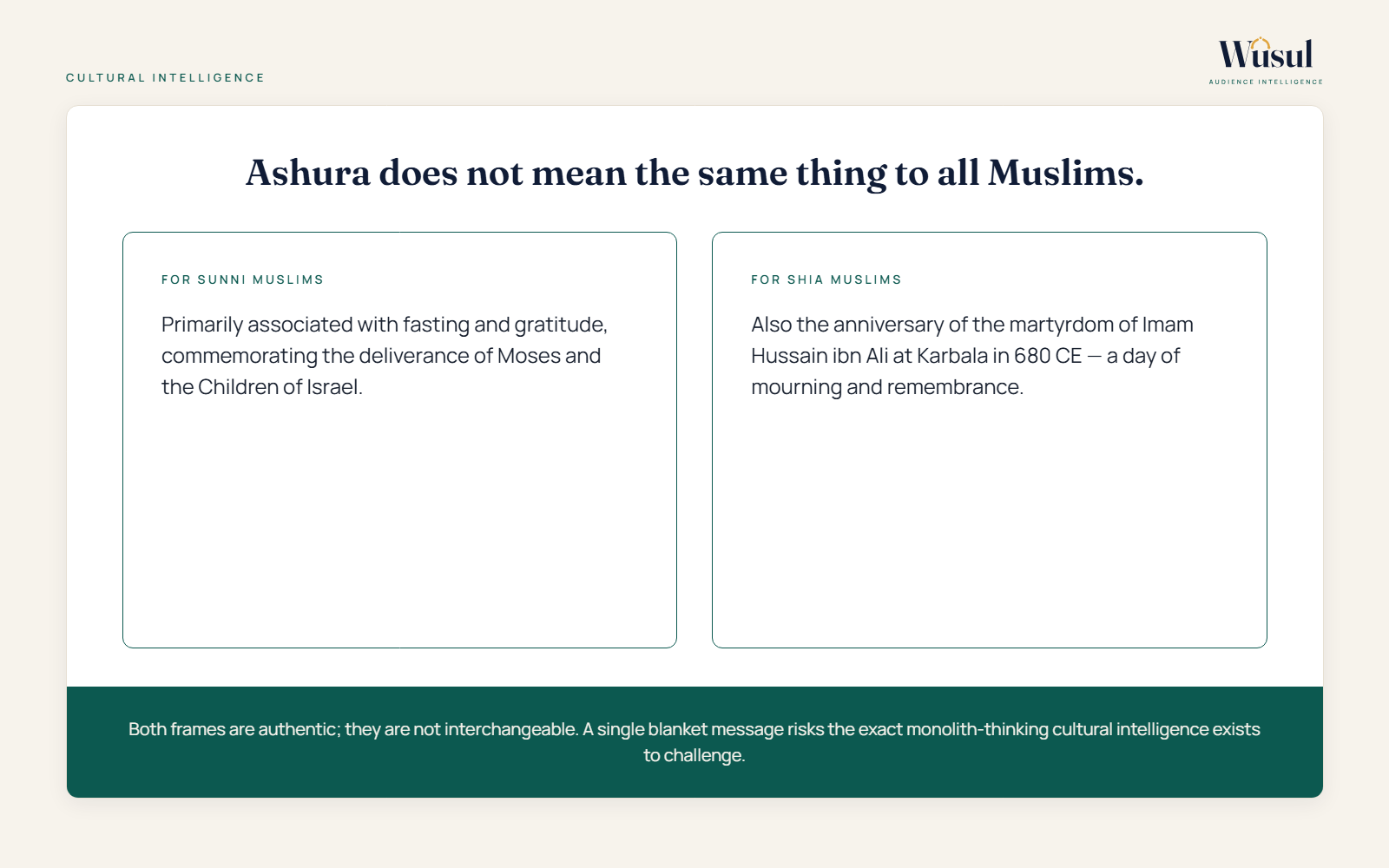
Several charities active in this space link their water-focused appeals specifically to the memory of Imam Hussain's companions being denied access to water at Karbala. Islamic Relief UK, for example, has run "Day of Ashura - Orphans & Water Appeal" campaigns. This is a meaningful frame for Shia donors, but one that should not be assumed to resonate the same way with a Sunni donor base; and vice versa for fasting-centered messaging.
The "fresh start" psychology
Muharram marks the beginning of the Hijri calendar year. Several Islamic organizations explicitly frame this as an opportunity for renewal. Muslim Aid notes: "Known as Muharram-ul-Haram, the Prophet Muhammad (PBUH) called it 'The Sacred Month of Allah.' All acts of worship and good deeds during this month earn extra reward and weigh heavier on the scales". Islamic Relief South Africa similarly describes Muharram as "a special time for reflection, worship, and drawing closer to Allah (SWT)" and "an opportunity to strengthen our faith, increase our good deeds, and seek Allah's mercy and forgiveness".
This framing is not a marketing invention; it draws on a genuine and widely used religious resonance between calendar renewal and spiritual recommitment. For donor re-engagement specifically, this is a more natural entry point than it might first appear. A donor who lapsed after Ramadan, or who gave once during Qurbani and didn't return, is a harder re-engagement target in October than in the weeks surrounding a new Islamic year. The "fresh start" framing gives a charity a legitimate, non-manipulative reason to reach back out: not "we haven't heard from you," but "here's a meaningful moment to begin again."
The UNFPA, for example, has leveraged this framing for maternal health appeals, noting: "As the month of Muharram ushers in the Islamic New Year, we reflect on new beginnings, hope, and resilience".
Muharram significance for charity and donor engagement strategies
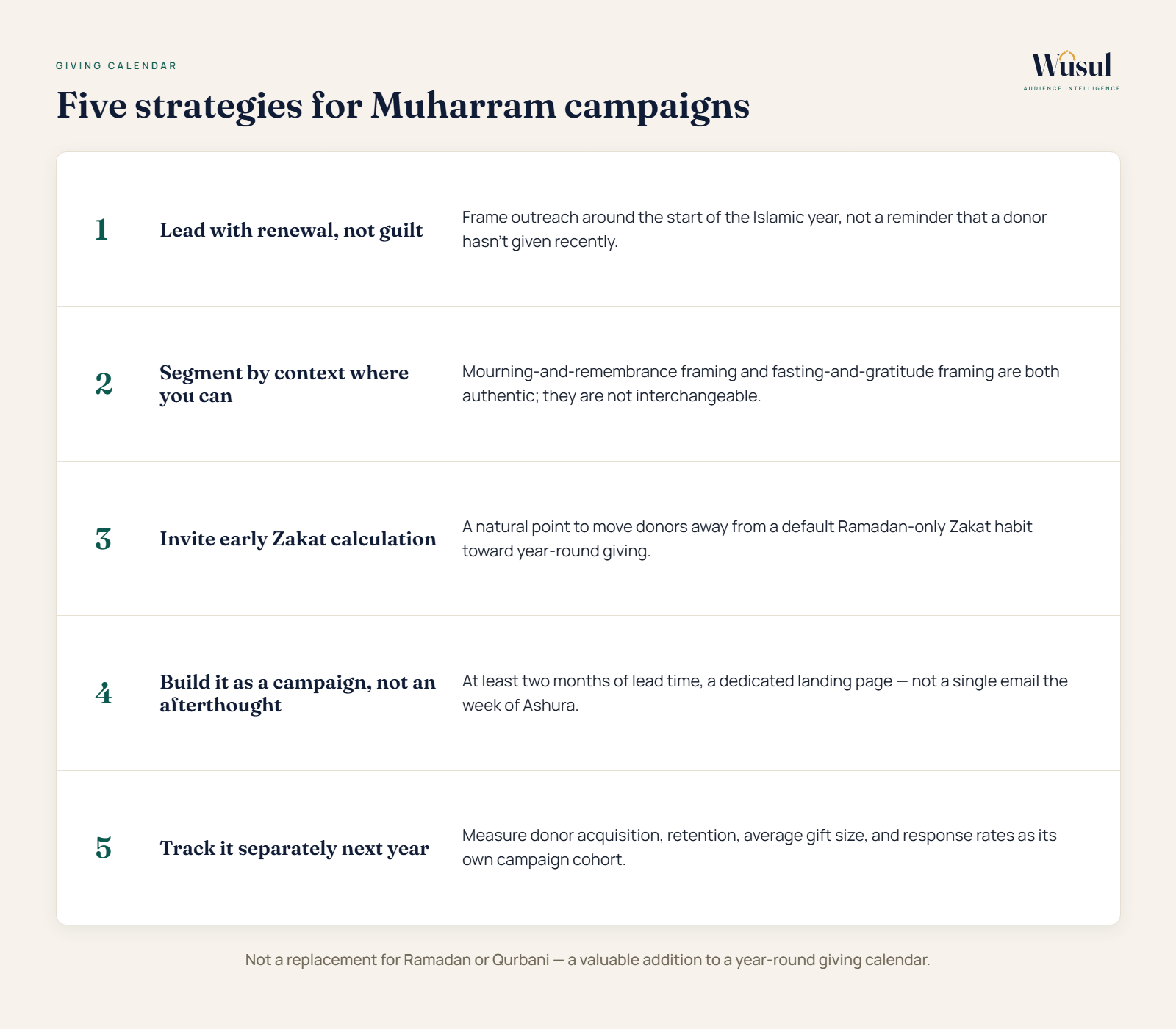
1. Lead with Renewal, Not Guilt
Frame outreach around the start of the Islamic year and the opportunity for spiritual renewal; not as a reminder that a donor hasn't given recently. The fresh-start frame works because it's genuinely positive, not because it's a softer way to ask for money. As Islamic Relief South Africa frames it, Muharram is "a chance to start the new Islamic year with purpose and gratitude".
2. Segment by Sunni/Shia Context Where You Can
If your donor base or audience composition allows it, avoid a single blanket "Ashura" message. Mourning-and-remembrance framing and fasting-and-gratitude framing are both authentic; they're just not interchangeable. Segmenting your messaging by donor context demonstrates cultural intelligence and respect for the diversity within the Muslim community.
3. Use Muharram to Invite Early Zakat Calculation
Position Muharram as a natural point to start thinking about the coming year's Zakat. Muslim Aid notes that giving during Muharram "can be a means for renewal in the lives of those facing immense hardship". This helps donors move away from a default Ramadan-only Zakat habit and builds a more sustainable year-round giving practice.
4. Build It as a Campaign, not an afterthought
Treat Muharram with the same lead-time and dedicated landing page treatment your organization already gives Ramadan and Qurbani. Avoid the temptation to send a single email the week of Ashura and call it a campaign. Proper planning, at least two months of lead time; allows for compelling storytelling, targeted outreach, and meaningful donor engagement.
5. Track It Separately Next Year
If your organization doesn't currently measure Muharram-specific giving as its own campaign cohort, start this year. It's the only way to know whether this season is genuinely underutilized for your specific donor base, rather than assuming it based on sector-wide patterns. Track key metrics: donor acquisition, retention, average gift size, and response rates compared to your other campaigns.
Final reflection
Muharram should not be described as a gimmick or a marketing invention. It is a sacred month with genuine religious depth; a month that the Prophet Muhammad (PBUH) singled out as the best month for fasting after Ramadan, one of the four sacred months mentioned in the Qur'an, and a time when acts of charity carry amplified spiritual weight.
The Prophet Muhammad encouraged Muslims to fast on the ninth and tenth of Muharram, and he described the Day of Ashura as a day of expiation for the sins of the previous year. This spiritual significance gives charities a legitimate reason to engage donors in a thoughtful way. The message is simple: a new Islamic year is beginning, and that is a meaningful time to renew intention, reflect on values, and give with purpose.
Done well, Muharram can become a credible and emotionally resonant season for charitable engagement; not a replacement for Ramadan or Qurbani, but a valuable addition to a year-round giving calendar that honors the full spiritual rhythm of the Islamic year.
At Wusul, we believe that cultural intelligence means recognizing the full spectrum of the Islamic calendar; not just the seasons that have historically received campaign infrastructure. Muharram is an invitation to engage donors with renewal, reflection, and purpose. By building campaigns that honor its spiritual depth, organizations can create meaningful touchpoints that strengthen donor relationships and deepen impact throughout the year.
Frequently asked questions
Why is Muharram a sacred month?
Muharram is one of four sacred months in Islamic tradition. Its name derives from an Arabic root meaning forbidden or sacred, which highlights its status as a time when fighting was traditionally prohibited. Scholars note that good deeds performed during these four sacred months carry amplified spiritual significance, making the month a time for reflection and worship.
What is Ashura?
Ashura is the tenth day of the month of Muharram. Its significance varies between traditions. For Sunni Muslims, it is a day of fasting and gratitude associated with the deliverance of Moses and the Children of Israel. For Shia Muslims, it is a day of mourning and remembrance for the martyrdom of Imam Hussain ibn Ali at the Battle of Karbala.
What is the Hijri calendar?
The Hijri calendar is the Islamic calendar, and Muharram marks the beginning of its new year. The start of this calendar year provides a natural moment for reflection, resolution, and spiritual renewal. Many Islamic organizations use this time to encourage donors to strengthen their faith and increase their good deeds as they begin the new year.