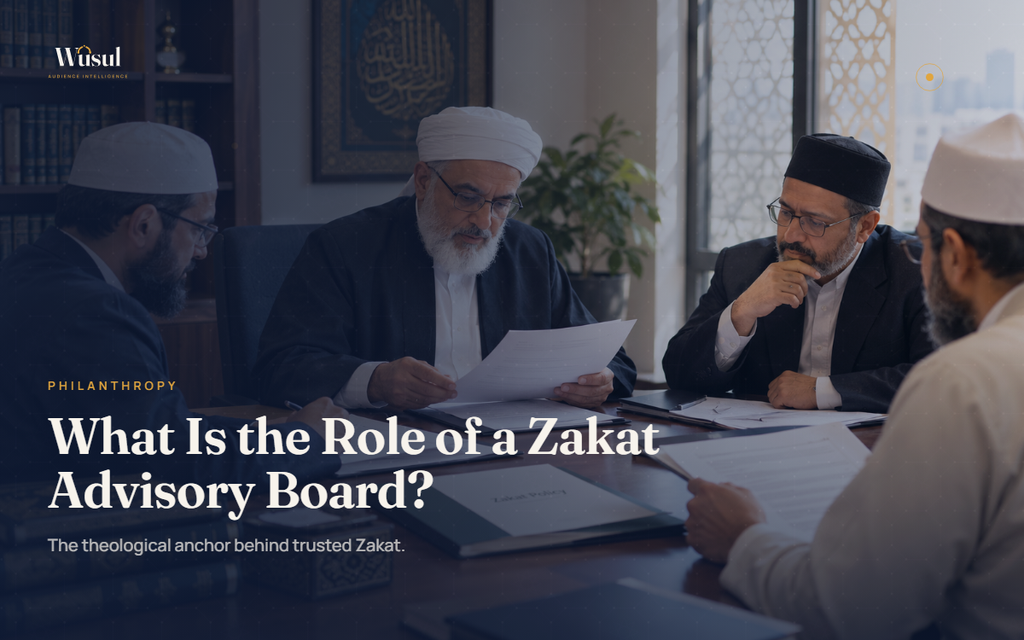
Across the Islamic charitable sector, one governance mechanism appears with remarkable consistency: the Zakat Advisory Board. Whether overseeing UNHCR's Refugee Zakat Fund or guiding Islamic Relief's global Zakat operations, these boards play a central role in ensuring that donations comply with Islamic jurisprudence. Just as importantly, they provide the religious oversight that helps reassure donors their Zakat is being distributed in accordance with Islamic principles.
What, then, is a Zakat Advisory Board? How does it operate, and why has it become a defining feature of modern Islamic philanthropy?
Zakat advisory board defined
A Zakat Advisory Board is typically composed of respected scholars with expertise in Islamic jurisprudence, particularly in matters related to Zakat. Their role is not operational; they do not manage funds or run programs. Instead, they serve as the theological authority that validates the organization's approach and holds it accountable to Islamic principles.
Islamic Relief's independent Zakat Advisory Board, made up of respected scholars, has ratified the organization's Zakat Policy and provides oversight and verification of the distribution of Zakat. Each board member provides advice to help ensure that every penny of Zakat is spent in accordance with Shariah and as efficiently as possible.
The board's composition matters. Islamic Relief's board includes Sheikh Mohammad Akram Nadwi, Sheikh Abdullah al-Judai, and Mufti Abdul Qadir Barkatulla; scholars with significant standing in the Muslim community.
The core roles and responsibilities
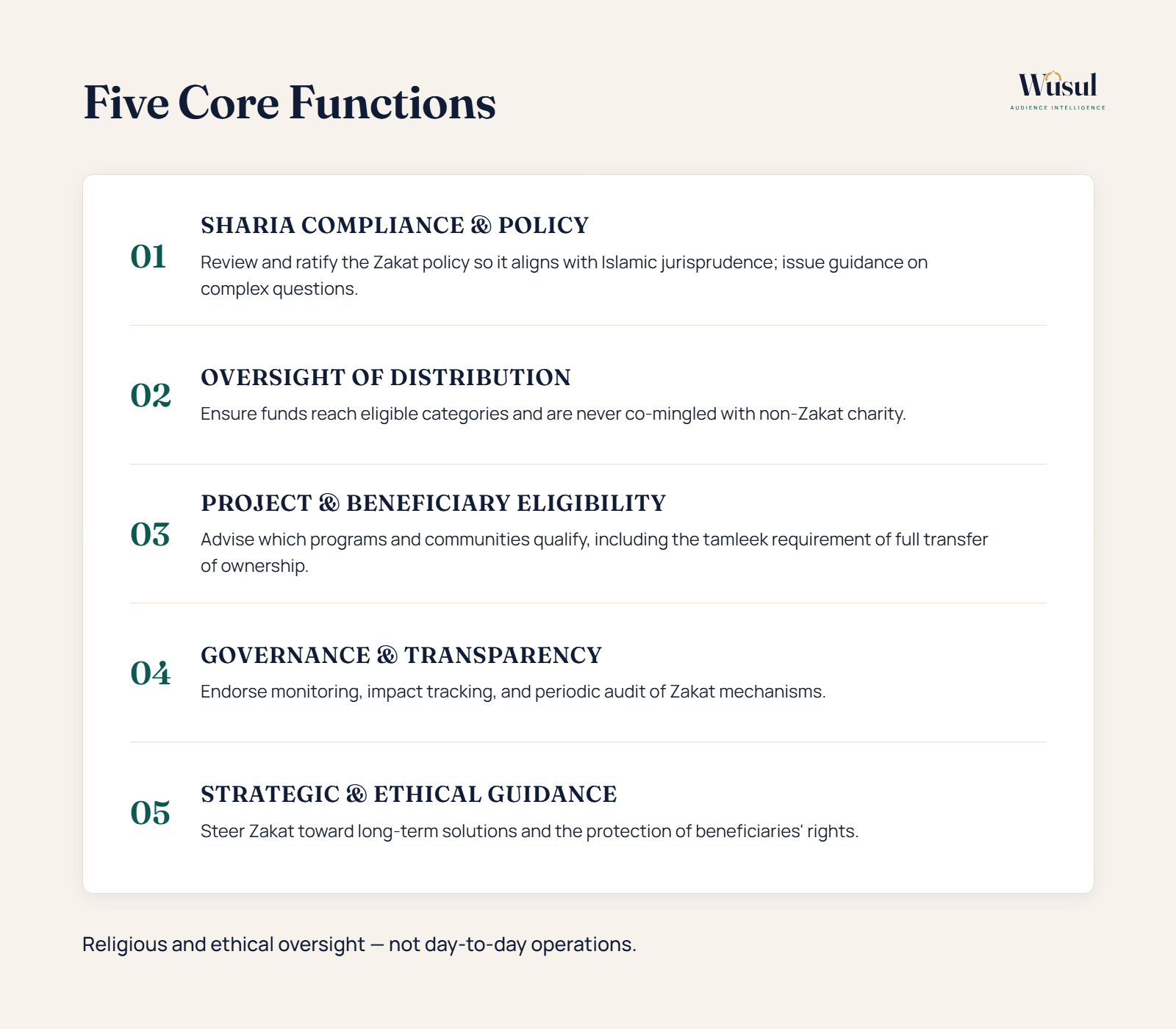
Across major international NGOs and Zakat institutions, the board's role typically includes five core functions.
1. Sharia compliance and policy ratification
The first and most fundamental function of a Zakat Advisory Board is to review and approve the organization's Zakat policy, so it aligns with Islamic jurisprudence.
This is not a formality. Islamic Relief's new Zakat Policy, for example, was finalized in 2022 after extensive consultation and expert input from three respected Islamic scholars. The policy outlines in detail the categories of eligible recipients, the conditions under which Zakat funds may be used, and the organization's approach to the administrative charge.
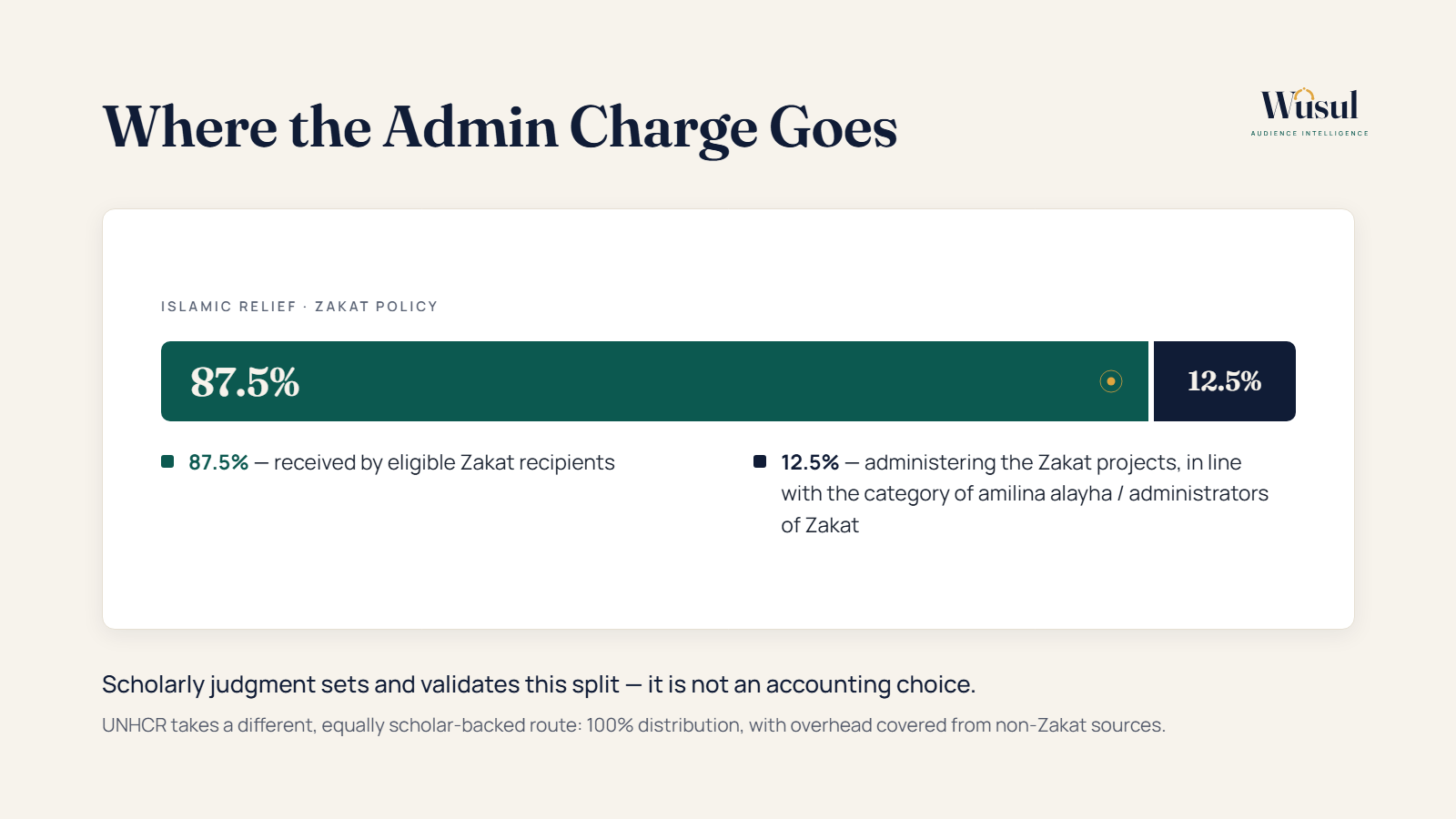
Islamic Relief sets its administrative charge at 12.5%, in line with the category of amilina alayha (administrators of Zakat). The policy specifies that a minimum of 87.5% of Zakat funds are received by eligible Zakat recipients, with the remaining 12.5% used to administer the Zakat projects.
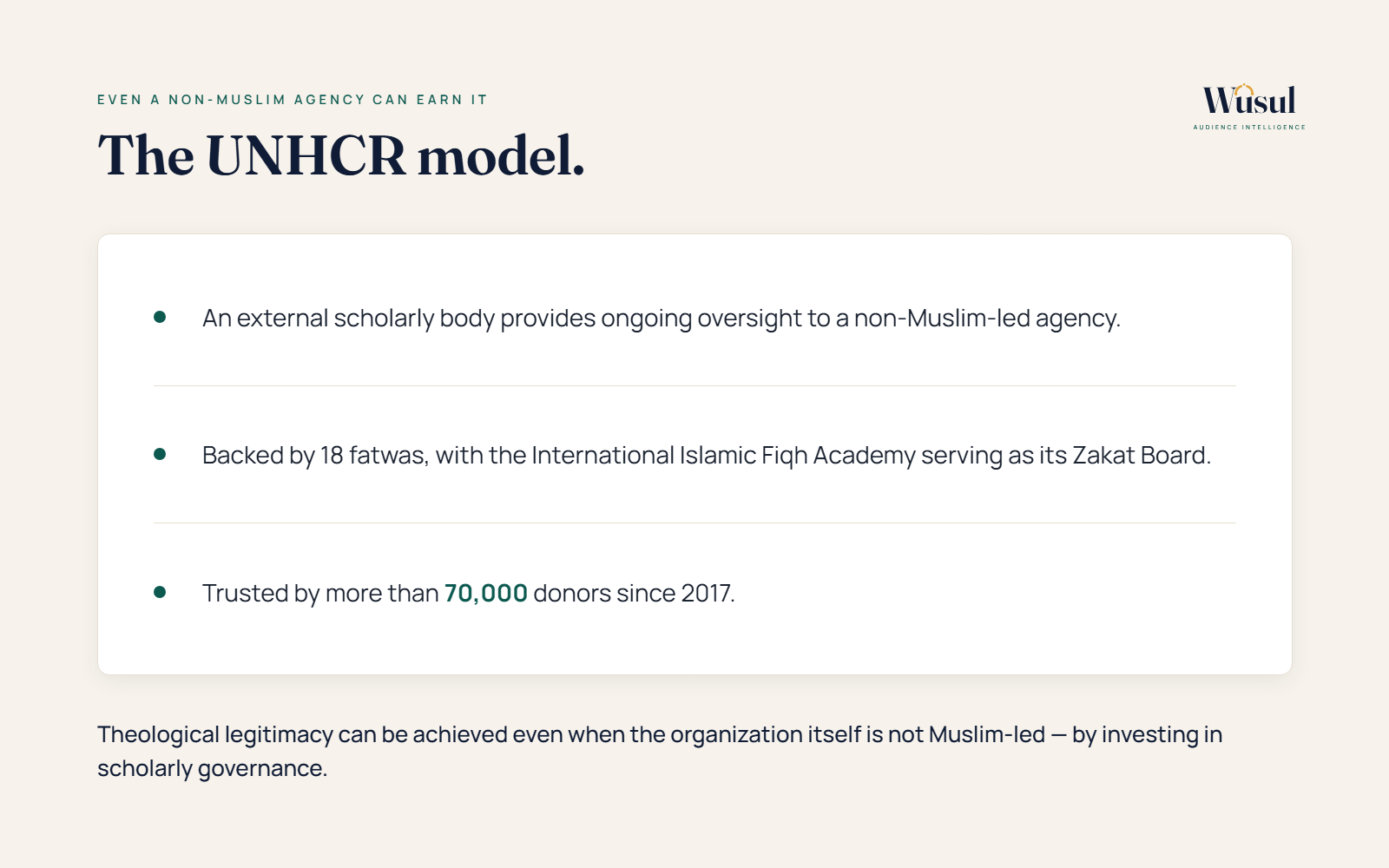
The board also issues guidance or fatwas on complex questions that arise in practice. These include eligible beneficiaries, support costs, and cross-border distribution. For UNHCR's Refugee Zakat Fund, the International Islamic Fiqh Academy serves as the Zakat Board, overseeing external compliance review.
2. Oversight of collection and distribution
The board provides high-level supervision of how Zakat funds are allocated to ensure they reach eligible categories and are not mixed improperly with non-Zakat charity.
UNHCR's Refugee Zakat Fund, for example, is backed by 18 fatwas from credible scholars and institutions, including the Islamic Research Academy of Al-Azhar, the International Islamic Fiqh Academy, and the Muslim World League. These fatwas validate the Fund's approach and provide ongoing theological assurance.
The board's oversight also ensures that Zakat funds are not co-mingled with other charitable funds. Islamic Relief's Zakat Policy specifies that Zakat funds cannot be used in cases where additional conditions are added for receipt, such as cash-for-work projects. This level of specificity requires scholarly judgment.
3. Project and beneficiary eligibility
A third critical function is advising on whether specific programs, communities, or restricted projects qualify to receive Zakat, and helping design Zakat -eligible interventions.
One of the most significant requirements in Zakat distribution is tamleek; the requirement that Zakat be handed over to the recipient as cash or in kind, such that they take ownership of it. According to the Jordanian Fatwa Department, Zakat must be given in the form of tamlīk (a full transfer of ownership), and it is not permissible to fulfill one's Zakat obligation by providing a benefit or service (manfa‘ah) such as housing, education, or medical treatment, in place of the Zakat itself.
This is a complex area of jurisprudence. Islamic Relief's Zakat Policy addresses it directly, stating that Zakat may be used for emergency relief activities such as food, shelter, clothing, medication, water and sanitation; items that can be directly transferred to beneficiaries.
The board also advises on geographical eligibility. Islamic Relief focuses its Zakat implementation in areas where there is a clear Muslim majority among the population, while ensuring non-Muslims in such situations receive the same level of assistance through additional funding from other sources.
4. Governance, transparency, and accountability
The board sets or endorses processes for financial transparency, monitoring, impact tracking, and periodic review or audit of Zakat mechanisms to reassure donors and regulators.
Islamic Relief's management of Zakat funds improved with the introduction of its new Amanah integrated digital finance system in 2023. The design for the new system incorporated the need for greater financial transparency and trackability, particularly with reference to Zakat funds. The organization provided practical training on zakat and its management to 400 staff across its global network.
For UNHCR's Refugee Zakat Fund, the 100% Zakat distribution policy serves both as an operational commitment and as a rhetorical device which enhances institutional credibility. Unlike other philanthropic organizations which take administrative overhead off the top of incoming donations, UNHCR promises to transfer all units of received Zakat funds to beneficiaries and cover operation and administrative expenses through other, non-Zakat sources of funding.
5. Strategic and ethical guidance
Finally, the board ensures that Zakat practice supports broader ethical aims; such as reducing poverty cyclically, protecting the rights of beneficiaries, and maintaining trust in fragile or humanitarian contexts.
Islamic Relief's Zakat Policy states that where possible, Zakat should be utilized in a way that provides long-term solutions to the deprivations or needs of disadvantaged people. This could be achieved through developing sustainable livelihoods projects, through education or health provision, or supporting other sustainable development activities for the poor and needy.
The policy also addresses the category of riqaab (emancipation of slaves), stating that where Islamic Relief finds people suffering from a modern form of slavery (such as bonded labor, forced labor, or human trafficking) Zakat funds may be utilized to emancipate people from such forms of slavery.
How it fits into organizational governance
In many non-state Zakat institutions, the advisory or Sharia Supervisory Board sits at a high governance level (equivalent in status to a board of commissioners) and works alongside management and internal Sharia compliance units.
Its mandate is primarily religious and ethical oversight rather than day-to-day operations, which are handled by management and internal compliance bureaus. This separation of functions is important: the board provides theological authority and oversight, while management handles execution.
For international agencies, the board may be an external scholarly body that provides ongoing guidance on policies, governance, and a compliance framework, reinforcing credibility with Muslim donors and partners. UNHCR's Refugee Zakat Fund, for example, has been trusted by more than 70,000 donors since 2017 and is backed by 18 Fatwas.
This model of an external body of scholars providing oversight to a non-Islamic organization demonstrates that theological legitimacy can be achieved even when the organization itself is not Muslim-led. As one academic analysis notes, the UNHCR Fund's legitimacy in the long term lies in how well it incorporates theological accountability into its institutional structure.
Why organizations need a Zakat advisory board
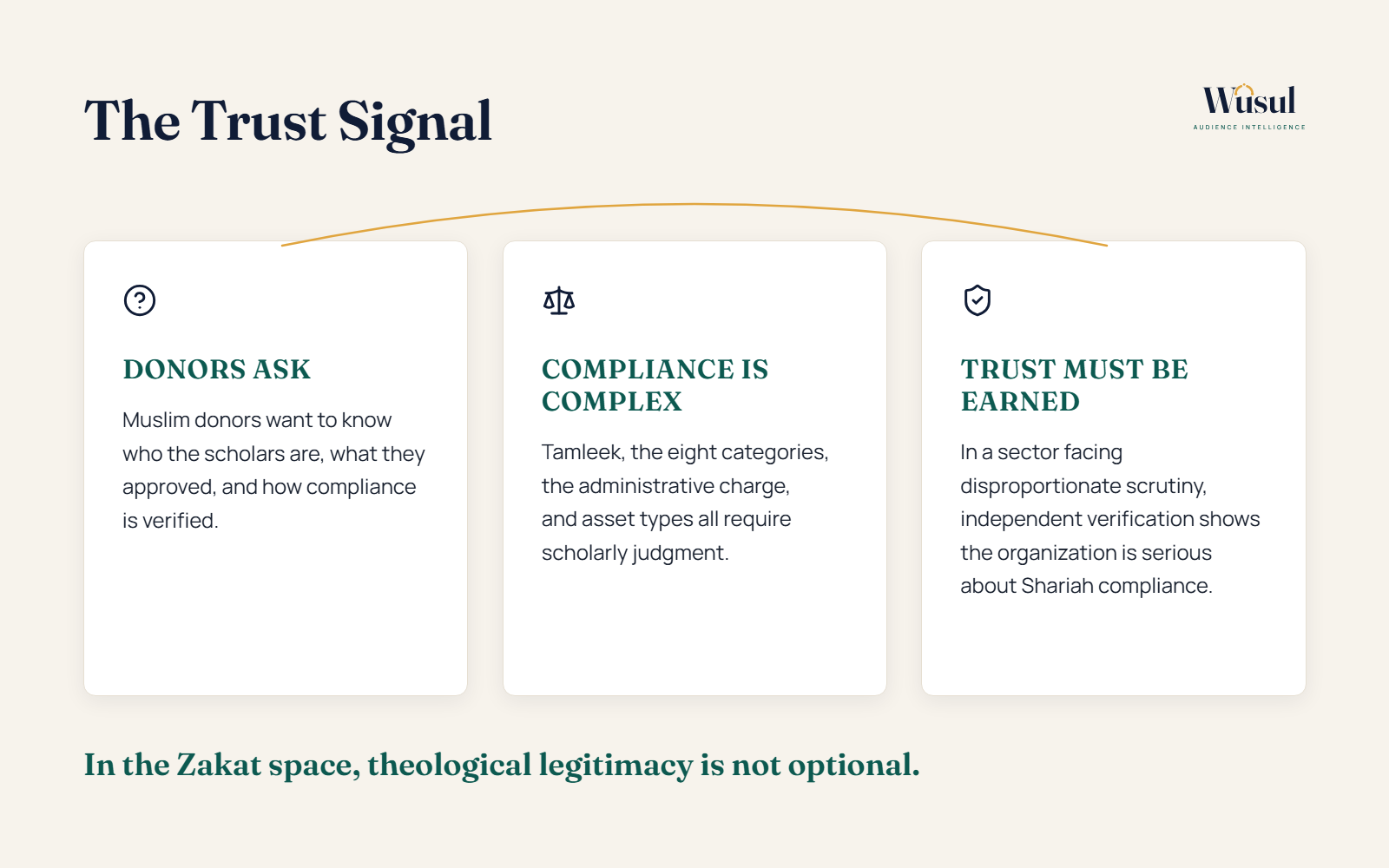
For organizations seeking to engage with Zakat donors, a Zakat Advisory Board is not optional. It is a baseline requirement.
Donors ask. Muslim donors increasingly want to know that their Zakat is being handled correctly. They want to know who the scholars are, what they have approved, and how compliance is verified.
Compliance is complex. Zakat law is not simple. Questions about tamleek, about the eight categories of recipients, about the administrative charge, and about the treatment of different types of assets all require scholarly judgment.
Trust must be earned. In a sector where Muslim charities face disproportionate scrutiny and where donors have legitimate concerns about compliance, a Zakat Advisory Board provides independent verification that the organization is serious about Shariah compliance.
Conclusion: the theological anchor
A Zakat Advisory Board is more than a governance formality. It is the theological anchor that grounds an organization's Zakat work in Islamic law and provides the trust signal that donors need to give with confidence.
For organizations seeking to enter the Zakat space (whether they are Muslim-led charities, international humanitarian agencies, or secular NGOs) a Zakat Advisory Board is the foundation upon which everything else is built. It is the body that ratifies policy, provides ongoing guidance, verifies distribution, and assures donors that their religious obligation is being fulfilled correctly.
As UNHCR's experience demonstrates, even a non-Muslim UN agency can build trust with Zakat donors; but only by investing in the scholarly governance that makes Zakat compliance credible. The lesson is clear: in the Zakat space, theological legitimacy is not optional. And a Zakat Advisory Board is how that legitimacy is earned.
At Wusul, we believe that cultural intelligence means understanding not just what an audience does, but why they do it; and respecting the boundaries they set. For organizations engaging with Zakat, the Zakat Advisory Board is not a bureaucratic requirement. It is the embodiment of that respect.
Frequently asked questions
What is a Zakat Advisory board?
A Zakat Advisory Board is a group of respected scholars with expertise in Islamic jurisprudence. Their role is not operational, meaning they do not manage funds or run programs. Instead, they serve as a theological authority that validates an organization's Zakat policies and holds the institution accountable to Islamic principles.
How does Zakat distribution work?
Zakat must reach the eligible categories and be kept separate from other charity. Many scholars also require tamleek, a full transfer of ownership to the recipient; the Jordanian Fatwa Department, for example, does not allow zakat to be paid as a service such as housing, education or medical treatment. Practice differs between bodies: Islamic Relief’s Zakat Policy lists emergency items such as food, shelter and medication, and also allows longer-term uses such as education or health provision where possible.
Why do charities need a Zakat board?
Charities use Zakat boards to ensure their operations comply with Islamic jurisprudence. These boards provide religious oversight, which helps reassure donors that their contributions are being distributed in accordance with Islamic principles. They also offer guidance on complex questions regarding beneficiaries, support costs, and the proper management of Zakat funds.